
B2B Distribution in Practice: The Reality of Rate Leakage in OTAs such as Expedia Group
The affiliation and redistribution ecosystem is, in practice, a highly complex network that is difficult to fully trace. The same inventory can flow through multiple channels: B2C, B2B, package paths, and affiliate networks. Along this journey, price ceases to be a static element under direct control and becomes transformed through multiple layers, often with limited visibility.
Daniel Bermejo Oyarzun
4/13/20262 min read
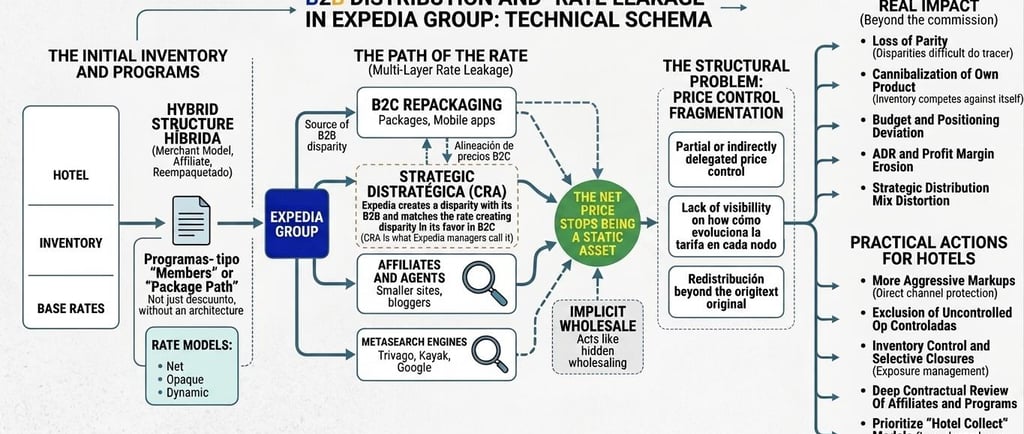
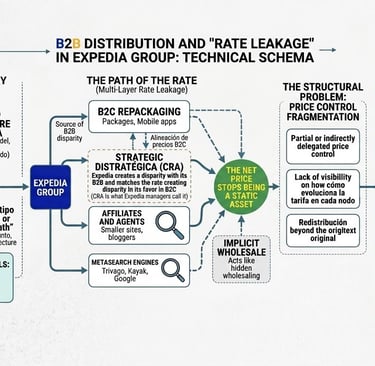
Within OTAs such as Expedia Group, the affiliation and redistribution ecosystem is, in practice, a highly complex network that is difficult to fully trace.
The same inventory can flow through multiple channels: B2C, B2B, package paths, and affiliate networks.
Along this journey, price ceases to be a static element under direct control and becomes transformed through multiple layers—often with limited visibility.
It Is Not a Discount. It Is Distribution Architecture.
Rate leakage in programs such as Members or Package Path is not simply a discount offered to the end customer.
It is a hybrid distribution architecture built on merchant models, affiliate networks, and inventory repackaging.
Hotel pricing is no longer a linear figure. It becomes a replicable distribution asset, reinterpreted across multiple layers: OTAs, metasearch engines, affiliates, and B2B networks.
From a revenue management perspective, this introduces a clear phenomenon: multi-layer rate leakage.
The net rate progressively loses traceability as it passes through intermediaries.
This is not merely a discounting issue. It is an effect that closely resembles implicit wholesale distribution, even when it is not formally structured as such.
The Real Problem
The issue is structural.
We are not simply dealing with discounts, but with an architecture designed to maximize distribution, where pricing control is no longer direct and becomes partially delegated throughout the chain.
Expedia Group maintains rules and agreements with affiliates, but traceability is not always complete.
The hotel loses visibility over how its rate evolves at each layer.
The B2B environment can amplify redistribution beyond its original context.
And this is where one of the most complex dynamics in the pricing journey emerges.
When a disparity is detected in B2C, Expedia Group may activate internal correction mechanisms to realign prices. In this process, a situation can arise where:
A disparity is created in B2B. The rate is then adjusted again, generating a new disparity—this time in favor of Expedia’s own B2C channel.
This type of internal correction logic, identified by Expedia as CRA, introduces an additional effect: the system does not merely react to disparities. it can redistribute them across the various layers of the ecosystem.
The result is clear: price control fragmentation.
The hotel may believe it controls the rates it distributes, but the final selling price is ultimately determined across multiple intermediate nodes.
Real Impact
This should not be measured solely in terms of effective commission, but also in terms of:
Loss of parity - Hard-to-trace disparities that damage the direct channel.
Product cannibalization - The same inventory competing against itself across different market points.
Budget deviation - Disruption of strategic positioning and forecasting accuracy.
Incremental ADR and margin erosion - Direct impact on profitability.
Distortion of distribution mix - Channel weight no longer reflects a deliberate strategy.
The Uncomfortable Reality
This is not a discount program.
It is a distribution infrastructure that turns hotel inventory into a highly liquid asset—but also one exposed to structural leakage that is extremely difficult to control.
What We Can Do in Practice
More aggressive markups to protect direct-channel profitability.
Excluding opaque rates to reduce structures that facilitate uncontrolled redistribution.
Inventory control through selective closures to limit exposure in high-risk channels.
Contractual review of affiliate programs to understand how far distribution actually extends.
Prioritizing Hotel Collect models to reduce dependence on merchant structures and their repackaging effects.
We are not managing prices alone.
We are managing increasingly complex distribution flows.
And in that environment, control is no longer absolute.
It is increasingly limited, indirect, and in many cases reactive rather than truly strategic.